Parcel-locker economics, line by line
A locker cabinet only saves money when it is busy. We break down the unit economics and the utilisation threshold that decides whether a location earns its keep.
By Elīna Bērziņa, VP of Operations
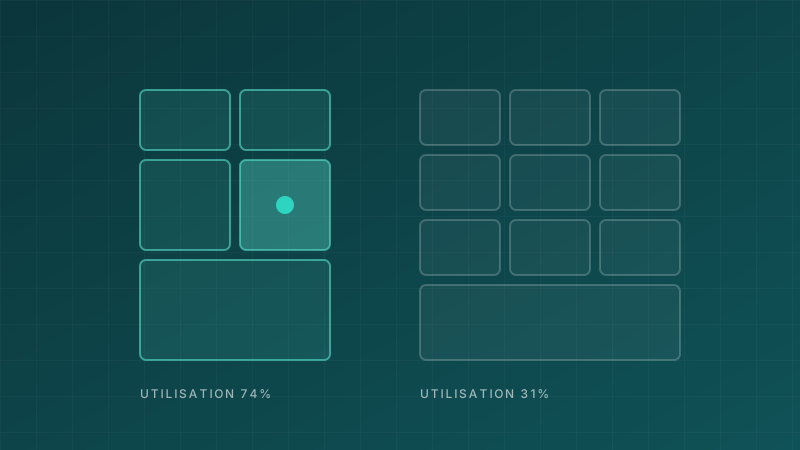
Parcel lockers get talked about as if they were free money — drop off twenty parcels in one stop, let customers collect on their own time, watch your cost per parcel fall. The reality is more interesting and less automatic. A locker is a fixed-cost asset, and like any fixed-cost asset it is only cheap per unit when it is busy. A quiet cabinet is one of the most expensive ways to deliver a parcel there is. The entire question is utilisation, so let us actually do the sums.
Where the savings come from
Delivering to a locker is cheaper than delivering to a door for two clear reasons. First, consolidation: instead of twenty separate stops with twenty separate walks to twenty separate doors, the courier makes one stop and deposits twenty parcels. On the density logic we have written about before, that is a dramatic collapse of servicing time. Second, no failed attempts: a locker is always "in". There is no ringing a bell to silence, no note through the door, no redelivery tomorrow at the same cost as today. The parcel goes in, the recipient gets a code, and the delivery is done.
Those two effects are real and large. A doorstep delivery in a Baltic city might cost somewhere in the region of €2.50–€3.50 all-in once you load in failed attempts. The marginal cost of adding a parcel to a locker run — the courier is stopping there anyway — can be a fraction of that. If that were the whole story, you would put a locker on every corner.
The costs the savings have to cover
But the cabinet is not free. Set aside the marginal cost of dropping a parcel and look at what the location costs you whether it is busy or not:
- Capital. A cabinet is a real piece of hardware — steel, compartments, electronics, a screen, connectivity. Amortised over its service life, it is a per-month cost that does not care how many parcels pass through.
- Site rent. The square metres it stands on are rarely free. A good location — outside a busy supermarket, by a transit stop — costs more precisely because it is good.
- Connectivity and power. Modest per unit, but constant.
- Maintenance and servicing. Doors jam, screens fail, someone has to clear a compartment when a parcel is abandoned. Field service visits are not cheap in labour terms.
- The visit itself. Even consolidated, the courier's stop has a cost, and a cabinet in a low-demand area might only justify a visit every other day, which hurts your delivery promise.
Add those up and you get a fixed monthly cost per cabinet. Divide that by the number of parcels the cabinet handles in the month and you get the fixed cost per parcel — and that number is entirely at the mercy of volume.
The utilisation threshold
Here is the mechanism that decides everything. Suppose a cabinet costs a fixed amount per month to own and operate, plus a small marginal cost per parcel. The total cost per parcel is the fixed cost spread across volume, plus that margin. At low volume the fixed cost per parcel is enormous — a cabinet handling fifty parcels a month is carrying its entire fixed cost across just fifty parcels. At high volume it becomes negligible.
Somewhere between those extremes is a break-even: the monthly parcel volume at which the all-in locker cost per parcel drops below what the same parcels would have cost delivered to the door. Below that threshold, the locker is losing you money on every parcel. Above it, the locker is winning, and it keeps winning harder as volume climbs.
A locker network is not a fleet of savings machines. It is a portfolio of fixed-cost bets, and the only thing that determines the return on each one is how many parcels flow through it.
In practice, for a typical Baltic cabinet, break-even lands in the range of a few hundred parcels a month. The cabinets outside busy supermarkets clear that easily and are enormously profitable. The cabinet somebody put in a quiet residential street "for coverage" may never reach it, and quietly loses money for years because nobody computes its unit economics after installation.
Managing the network, not the cabinets
This reframes locker strategy entirely. The job is not to install lockers; it is to manage a portfolio so that as many cabinets as possible sit above their break-even line. That means three ongoing disciplines.
Measure per-cabinet utilisation, always. Occupancy over time, parcels per month, dwell time. The cabinets below the line should be visible at a glance — they are your problem children, and you either drive volume to them or decommission them.
Steer volume actively. Utilisation is not fixed; you influence it. Offering a nearby locker at checkout, defaulting eligible parcels to lockers where the customer is willing, and diverting to a locker after a failed doorstep attempt all push parcels toward cabinets that have room. A cabinet at forty percent utilisation and one at ninety are a routing decision away from being balanced.
Site on data, not intuition. New cabinets should go where the demand model says break-even is comfortable, not where a site happened to be available. The best predictor of a cabinet's future volume is the delivery density already in its catchment.
The number to put on the wall
If your locker network does not have a per-cabinet utilisation report that everyone can see, that is the first thing to build — before you install another door. Once you can see which cabinets are above the line and which are below it, every other decision gets easier: where to add, where to remove, where to push volume, what to promise customers. Lockers genuinely are one of the best tools in Baltic last-mile logistics. They are just not automatic, and the difference between a network that prints money and one that leaks it is a single column of numbers most operators never look at.
See your locker network's utilisation
Kelvara gives you per-cabinet occupancy curves and break-even flags across every cabinet you own or buy access to.
Explore locker orchestration